
DevSecOps and FPGA Certification in Aerospace
trait de séparation
Reading Time: 7-9 minutes - June 2026
Cybersecurity has become a key concern for safety‑critical aerospace systems. With the introduction of the ED‑203A standard, certification authorities now require cyber risks to be addressed from the earliest design stages, in the same way as safety concerns.
In this context, FPGA components play a strategic role. Widely used to implement sensitive functions such as encryption, data filtering, and secure communications, FPGAs rely on HDL code (VHDL/Verilog) that can contain exploitable vulnerabilities. Yet traditional approaches derived from DO‑254, which focus primarily on safety, do not explicitly address cyber threats.
The reference article demonstrates that a hardware-oriented DevSecOps approach, combined with static analysis and formal methods, provides an effective way to meet ED‑203A cybersecurity objectives while significantly improving the robustness of FPGA designs.
The Limits of Traditional DO 254 Practices in Addressing Cyber Risks
The DO‑254 standard provides a solid framework for demonstrating the safety of complex electronic hardware. However, it does not explicitly cover cybersecurity threat scenarios targeting the internal logic of FPGA designs.
The article highlights several categories of risks that are typically overlooked:
This clearly calls for a complementary cybersecurity-focused approach, fully integrated into FPGA development workflows.
The article highlights several categories of risks that are typically overlooked:
- Out-of-bounds memory or vector accesses leading to corruption or unintended execution
- Unreachable states or dead code potentially hiding design errors or backdoors
- Finite State Machines exhibiting dead states, livelocks, or ambiguous behaviors
- Violations of secure coding rules (signal initialization, state management, critical combinatorial logic)
This clearly calls for a complementary cybersecurity-focused approach, fully integrated into FPGA development workflows.
Embedding FPGA Cybersecurity Through a DevSecOps Approach Compliant with ED 203A
To address ED‑203A requirements effectively, the article proposes an innovative methodology based on three complementary pillars.
Secure by Design with DevSecOps
Independent and Traceable Reviews
Full Traceability and Certification Evidence
This approach makes it possible to reconcile cybersecurity, regulatory compliance, and development agility, avoiding the trade-offs typically imposed by traditional processes.
Secure by Design with DevSecOps
- Continuous detection of vulnerabilities as HDL code is written
- Native integration of security controls into FPGA design flows
- Automated checks triggered at each change through hardware-oriented CI/CD pipelines
Independent and Traceable Reviews
- Systematic use of Pull / Merge Requests
- Enforcement of independent reviews as required by certification standards
- Preservation of review evidence (checklists, findings, corrections, approvals)
Full Traceability and Certification Evidence
- Direct linkage between security rules, source code, analysis results, and fixes
- Automatic generation of auditable evidence supporting ED‑203A objectives (EASA, DGA)
This approach makes it possible to reconcile cybersecurity, regulatory compliance, and development agility, avoiding the trade-offs typically imposed by traditional processes.
Linty: Securing and Certifying FPGA Designs with Static Analysis and Formal Methods
Linty at the Core of the Approach
Linty is an advanced static analysis tool dedicated to VHDL code, specifically designed for safety‑ and security‑critical environments. Integrated directly into development environments (e.g. VS Code), it enables real-time detection of hardware-level vulnerabilities.
Automated Detection of HDL Vulnerabilities
Linty identifies, among others:
Making Formal Methods Accessible
One of Linty’s key contributions is democratizing the use of formal methods for FPGA designers:
The result is mathematically sound evidence, naturally integrated into a DevSecOps workflow.
Linty is an advanced static analysis tool dedicated to VHDL code, specifically designed for safety‑ and security‑critical environments. Integrated directly into development environments (e.g. VS Code), it enables real-time detection of hardware-level vulnerabilities.
Automated Detection of HDL Vulnerabilities
Linty identifies, among others:
- Out-of-range memory or index accesses
- Unconnected, constant, or non-registered output ports
- Dead code, unreachable branches, and suspicious logic patterns
- Violations of secure coding rules
Making Formal Methods Accessible
One of Linty’s key contributions is democratizing the use of formal methods for FPGA designers:
- Automatic generation of mathematical assertions
- Proofs of absence of critical vulnerabilities (e.g. arithmetic overflows, FSM flaws)
- Formal detection of dead states, unreachable states, livelocks, and redundant states
The result is mathematically sound evidence, naturally integrated into a DevSecOps workflow.
Industrial Benefits and Feedback: Toward Faster and Safer Certification
The practical application of this approach—particularly on the CNES Athena X‑IFU project—resulted in:
Beyond civil aerospace, this methodology is fully transferable to other safety‑critical domains, including defense, space, automotive, rail, medical, and nuclear industries.
- A drastic reduction in residual defects within the VHDL code
- Early identification of hardware cybersecurity vulnerabilities
- A dramatic acceleration of validation, verification, and certification cycles (up to 300%)
- Improved continuity between DO‑254 (safety) and ED‑203A (cybersecurity) processes
Beyond civil aerospace, this methodology is fully transferable to other safety‑critical domains, including defense, space, automotive, rail, medical, and nuclear industries.
This approach demonstrates that it is possible to combine regulatory compliance, cybersecurity, and agility in the design of critical FPGA components by relying on a tool‑driven DevSecOps methodology, with Linty as a cornerstone.
To explore the methodology in depth, including technical mechanisms, vulnerability examples, and compliance evidence with ED‑203A and DO‑254, we invite you to read the complete article.
To explore the methodology in depth, including technical mechanisms, vulnerability examples, and compliance evidence with ED‑203A and DO‑254, we invite you to read the complete article.

Ces articles peuvent vous intéresser

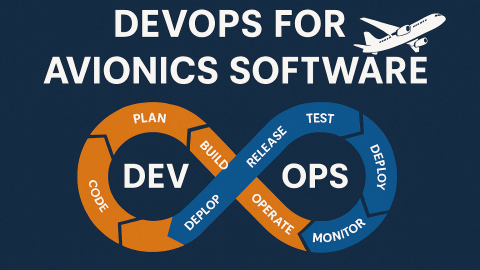
Devops for avionics software
Framework and tooling proposals for Agile certification of safety-critical embedded software in avionic systems.